
Qualifications & Standards

Surveys are carried out by a surveyor holding the ABBE Level 3 Award in Damp, Mould & Condensation, supported by IICRC Applied Microbial Remediation Technician (AMRT) and IICRC Water Damage Restoration Technician (WRT). Revenge Kleaning Services Ltd is an IICRC Certified Firm (IICRC Firm No. 70248961).

Damp, Mould & Moisture Surveys

Most damp and mould problems get misdiagnosed. Condensation gets put down to rising damp, a failed gutter gets blamed on the tenant, and the same wall gets redecorated three times before anyone measures anything.

A survey establishes what is actually happening. We take moisture readings across the fabric, record the environmental conditions, and work out which of the possible causes the evidence supports and which it rules out. You get a written report setting out findings, cause, extent and what needs to happen next.

We survey across Wigan, Greater Manchester, Lancashire, Merseyside and Cheshire.

Diagnosis, not guesswork

Condensation, penetrating damp, moisture held in the fabric, a plumbing defect and construction moisture all look similar on a wall, and each needs a different solution. We separate them using instrument readings and environmental data rather than a visual opinion, and we state how confident we are in each conclusion.

Evidence you can rely on

Every finding is supported by recorded data: moisture readings, relative humidity, air and surface temperatures, dew point, thermal imaging and a full photographic record. Where it adds value we can take air or surface samples for laboratory analysis. If the report is going to a tenant, a housing officer, an insurer or a solicitor, it needs to hold up.

No obligation to instruct us

The survey is a standalone service. Recommendations are based on the inspection evidence, and you are free to use another contractor for any works that follow. If your building needs a ventilation upgrade or a roofer rather than remedial works, that is what the report will say.

Who it is for

What you can instruct

Three scopes, agreed before the inspection is booked. We decide the appropriate diagnostic methods within the scope, so you do not have to work out what your property needs before you call.

Standard Property Investigation

Our core damp, mould and moisture survey, non-destructive throughout, with no opening-up. Visual inspection inside and out, thermal imaging, moisture readings across the affected areas to establish extent and whether moisture sits at the surface or within the material, environmental and condensation risk assessment, and assessment of ventilation provision and building fabric.

Suitable for: most damp and mould problems, including recurring mould, tenant complaints, disrepair and pre-purchase concerns.

Targeted Investigation

Where a specific concern requires closer investigation, the survey can be extended using appropriate diagnostic methods:

  • Comparative moisture mapping and moisture pathway assessment
  • Ventilation and extract performance testing, with measurement of extract airflow rates
  • Timber moisture assessment
  • Borescope inspection through suitable existing access points

The methods used are selected by us according to the property, the evidence identified and the purpose of the investigation.

Suitable for: concealed or suspected defects, and cases where the standard investigation leaves a specific question open.

Sampling & Laboratory Services

Targeted sampling and independent laboratory analysis. This runs alongside either of the above rather than replacing them, and it is not a more thorough version of a survey. Sampling is recommended where laboratory evidence is expected to answer a relevant question or materially assist the investigation. It is not routinely added where it would not change the assessment.

Suitable for: disputes and disrepair, suspected contamination that is not visible, and comparison against an unaffected area.

Not sure which you need? Tell us what you are dealing with and we will help establish the appropriate scope before the inspection is booked.

Included in every survey

Supporting housing providers under Awaab's Law

Awaab’s Law has applied to social landlords in England since 27 October 2025 for emergency hazards and significant damp and mould hazards. Phase 2 extends the significant hazard requirements to further hazard groups from 30 November 2026.

The statutory duties below sit with the landlord. Our survey provides the investigation and the written evidence that support a landlord in meeting them.

24 hours

Emergency hazards
Investigated and relevant safety work completed, from becoming aware

10 working days

Significant damp & mould hazards
Investigation completed, from becoming aware

3 working days

Written summary
Provided to the named tenant after the investigation concludes

5 working days

Relevant safety work
Completed, where the investigation identifies a significant hazard

Where no further investigation or laboratory analysis is required, we normally issue our report within 2 working days of attending, so that findings and evidence reach a landlord quickly. Where sampling is required the report is completed once the results are available, and we will tell you that at the point of instruction. The statutory periods above run from the points set out in the legislation, not from our attendance, and it remains for the landlord to determine how their duties apply to a particular case. Where remedial works follow, our remediation service aims to attend within 2 working days of receiving a complete instruction.

Our Process

1. Instruction and access

We agree scope and fee up front and arrange access. For tenanted properties we can liaise with the occupant directly or through you.

2. Visual inspection

Internal and external inspection of the affected areas and the building fabric, covering construction, rainwater goods, ground levels, ventilation provision, and how the property is being occupied and heated.

3. Moisture profiling

Calibrated readings taken across walls, ceilings, timber and adjacent surfaces using pin, pinless and hammer probe instruments, to establish whether moisture sits at the surface or within the material, and how it is distributed.

4. Environmental and thermal assessment

Relative humidity, air temperature, surface temperature and dew point recorded to establish condensation risk and identify surfaces where moisture will form under normal occupation. Thermal imaging is used to locate cold bridging and temperature anomalies across whole walls and ceilings rather than at spot readings alone. Thermal imaging shows surface temperature, not moisture, so anything it flags is confirmed with moisture readings before it appears in the report.

5. Sampling, where appropriate

Where visual inspection and readings do not settle the question, or where a result needs to stand up in a dispute, we take air or surface samples for independent laboratory analysis. We will tell you if sampling would not add anything rather than charging for it by default.

6. Analysis and report

The readings and inspection evidence are analysed together to determine which cause or contributing factors the evidence supports and which it does not. Where no further investigation or laboratory analysis is required, your report is normally issued within 2 working days of the survey. Where sampling or laboratory analysis is required, the report is completed once the necessary results are available. If the evidence remains inconclusive, the report says so rather than picking the convenient answer.
Real site readings

Findings are supported by recorded data, not visual opinion. These are readings taken on live RKS surveys.
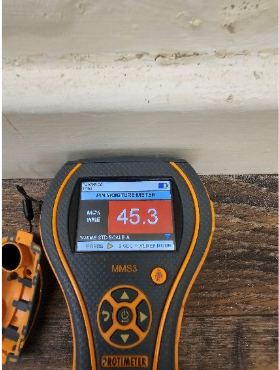
Pin moisture reading confirming elevated moisture levels within timber
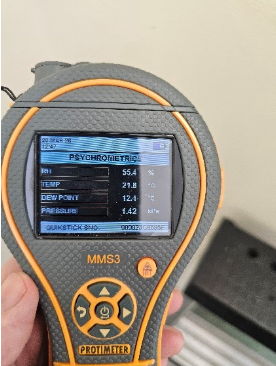
Internal environmental readings including humidity, temperature and dew point, establishing overall conditions within the property
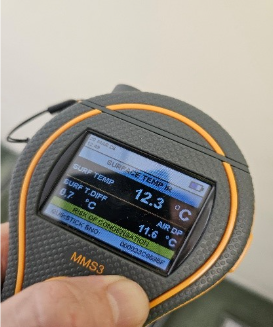
Surface temperature and condensation risk assessment, identifying areas prone to moisture formation

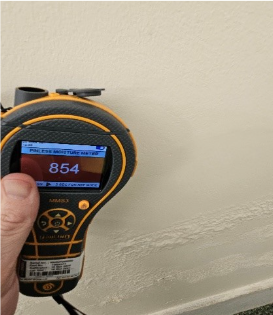
Pinless moisture readings used for quick, non-intrusive assessment of surface level moisture

Common questions

What is the difference between a survey and a quote?
A quote prices a job somebody has already decided on. A survey establishes what the problem actually is and what it will take to resolve it, and the report stands on its own whether or not you instruct us afterwards. If you already know the cause and you want a price for remedial works, you do not need a survey.
Yes, both, with independent laboratory analysis. We do not take them as a matter of routine. Where mould growth is visible and the readings explain it, sampling usually adds cost without changing the conclusion. Sampling earns its place where contamination is suspected but not visible, where a result needs to stand up in a dispute, or where you need a comparison against an unaffected area. We will say which applies before you commit to it. Laboratory analysis takes longer than our standard report turnaround, so where sampling is required the report is completed once the results are in rather than issued ahead of the evidence. We will tell you the expected timescale when we agree the scope.
Comparative moisture mapping means taking readings systematically across an area rather than at a few spots, so the distribution and relative severity can be seen as a pattern. That pattern is then considered alongside the building construction, observed defects, environmental and thermal evidence and site observations to assess how moisture is likely to be moving through the fabric. To be clear about what the instrument does: a moisture meter shows distribution and relative severity. It does not identify a pathway on its own. The pathway is a conclusion drawn from the pattern read against the rest of the evidence, and the report states how confident we are in it.
Yes, where extract performance testing is instructed. There is a difference between recording that a fan is fitted and measuring what it moves. A fan can run, sound normal and still shift far less air than the room needs, through a blocked or crushed duct, a long run, a failed shutter or simply being undersized. Where that matters to the diagnosis we measure the extract airflow rate and report it against the provision the room requires, rather than recording that a fan is present and leaving it there.
Yes. It lets us see temperature variation across a whole wall or ceiling rather than relying on spot readings, which is how cold bridging and poorly insulated areas get found. One thing worth being clear about: a thermal camera shows surface temperature, not moisture. It is often presented as a damp detector and it is not one. Anything it flags is confirmed with moisture readings before it goes in the report as a finding.
You cannot tell from the appearance of the damp alone, and that is the whole point. Condensation, penetrating moisture, plumbing defects, bridging of the damp proof course, construction moisture and other forms of ground related moisture can all produce overlapping symptoms. Genuine rising damp can occur, but it should not be assumed simply because dampness or raised moisture readings are present at low level. The difference matters because the remedies are completely different, and an injected damp proof course will not correct a problem caused by another mechanism. The survey assesses which mechanism the evidence supports, which it does not support, and where further investigation is needed, rather than starting from an assumption in either direction.

We can, if the works fall within mould remediation and decontamination. We are not a building contractor, so roofing, plumbing, ventilation installation and fabric repairs go to the appropriate trade. The survey is charged and issued independently, and you are under no obligation to instruct us for anything that follows.

A thorough property survey will typically take at least two hours on site. The actual time required depends on the size and construction of the property, the number and extent of the areas being investigated, and the scope of the survey. More complex investigations may take considerably longer.
It depends on the property, the number of areas involved and whether sampling is needed. Tell us what you are dealing with and we will give you a fixed price before anything is booked. There are no variable extras added afterwards.

Wigan, Greater Manchester, Lancashire, Merseyside and Cheshire, including Ashton-in-Makerfield, Ince, Hindley, Leigh, Atherton, Tyldesley, Golborne, Standish, Orrell, Shevington, Bolton, Warrington, St Helens, Salford and Manchester.

Fill Out The Form To Get A Free Quote.